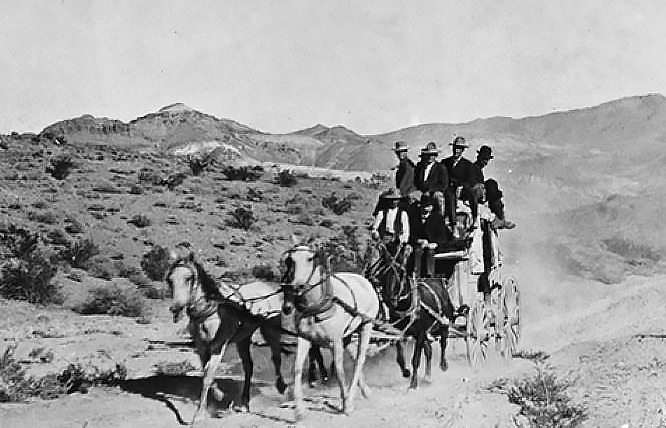
 Click on photo for more information.
Visit the Historic Butterfield Overland Mail Stage Sites in Tulare County
by Laurie Schwaller
On October 8, 1858, near midnight, the first Butterfield Overland Mail Stage thundered into Visalia, inaugurating regular, reliable, twice-weekly mail delivery from the east coast for the first time in California’s history.
Both Tulare County and Visalia, its county seat, had been established only six years before, but Visalia, with about 500 residents, was also the oldest San Joaquin Valley town between Los Angeles and Stockton as well as the largest Butterfield way station in what was then a much larger Tulare County. And since Visalia served as an Overland Mail timetable location, it was listed on all of Butterfield’s stage schedule literature.
A big crowd on Visalia’s Main Street enthusiastically greeted the stage. After its 20-minute stop to change horses and allow the driver and his passenger some food and refreshment (there were no stops for sleep on the Butterfield line), the stage raced away, hailed by a memorable anvil salute. Two days later, the Overland Mail arrived at San Francisco’s post office, completing its arduous 2,800 mile trip from St. Louis in 23 days and 23-1/2 hours, a day ahead of its contract schedule.
On September 16, 1857, the U.S. government had awarded John Butterfield a $600,000 contract (the largest land-mail contract ever awarded in the U.S. to date) to transport mail twice weekly year-round between St. Louis, Missouri, and San Francisco within 25 days each way. He had to commence that vital service, at such unheard of speed, within just one year.
Butterfield invested (in association with the principals for Wells, Fargo & Co.) over a million dollars in building or repairing roads and bridges; creating around 150 way stations (eventually about 170), many with living quarters, corrals, barns, and wells; purchasing stagecoaches and ancillary wagons; buying horses, mules, livestock feed, and provisions for staff and passengers; and hiring 800 employees to man the service from Missouri through Arkansas, Indian Territory (now Oklahoma), Texas, New Mexico, Arizona, and California.
He chose this southern (“Oxbow”) route, although it was hundreds of miles longer than a direct route from St. Louis to San Francisco, because it would avoid the delays caused by having to cross the higher and more numerous mountain ranges to the north, with their severe winter weather.
His first Overland Mail Stage left St. Louis on September 15, 1858, exactly meeting his contract’s deadline. Abiding by his famous rule, that “Nothing on God’s earth must stop the United States mail,” the Overland Stages almost never failed to get their mail, freight, and passengers through within the 25-day limit. The nation’s rapidly expanding population was thrilled to find itself connected at this astonishing speed.
But in March, 1860, John Butterfield, facing escalating operational debts, was forced out as president of his Overland Mail Company, and Wells, Fargo and Co. directors (some of his main creditors) took it over. One year later, at the beginning of the Civil War, Congress ordered the overland mail stages to cease service on their suddenly unsafe southern route and move their operation to the “Central Overland California Route” (basically the route of the Pony Express, which operated from April, 1860, until October, 1861, when it was terminated as the transcontinental telegraph line was completed).
The central route traveled through Nebraska, crossed the Rockies over South Pass to Salt Lake City, then traversed the deserts of Utah and Nevada, struggled over the Sierra Nevada to Placerville, and terminated in San Francisco. Tulare County was no longer on its way.
The last Butterfield stage on the southern, Oxbow, run left St. Louis on March 18, 1861, and reached San Francisco on April 13. But Butterfield’s trail did not die. Since its inception, his southern route, with its clear course, many improvements, and vital developed water supplies, greatly encouraged and aided emigrant and other travel to the West and California, including Tulare County. Its substantial use continued until the completion of the railroad in 1880.
As President Buchanan foresaw, in his 1858 congratulatory letter to Butterfield when service commenced on his trail: “It is a glorious triumph for civilization and the Union. Settlements will soon follow the course of the road, and the East and West will be bound together by a chain of living Americans, which can never be broken.”
In 2023, the Butterfield Overland National Historic Trail (NHT) was added to the National Trails System to commemorate the Butterfield Overland Mail’s impact on the shaping of our nation. In Tulare County, several of the Butterfield stage station sites are commemorated with historic markers, and trail buffs can drive part of the stages’ route today on scenic paved roads.
Visalia’s marker, at 116 E. Main Street, celebrating the first Butterfield stage’s arrival, is very near where that stage actually stopped, greeted by that famous anvil chorus.
Lindsay’s marker, at the southwest corner of the junction of Highway 65 and Ave. 228/Hermosa St., memorializes the historic route. Lindsay also honors the Overland Stage with a big (10′ x 45′) colorful mural nearby, at 160 N. Elmwood Avenue.
Porterville’s Tule River Stage Station marker stands in a little city park, where “Peter Goodhue operated an emigrant trail stopping place on the banks of the Tule River from 1854 until the river changed its course in 1862. This became a Butterfield Overland Mail Stage Station, 1858-61.”
From Porterville, the historic Old Stage Road leads south to Fountain Springs, where the road’s memorial marker sketches its long history. “Running north and south, following an older Indian Trail is the route . . . [that became] the first public road in Tulare County.” It then lists some of the road’s famous travelers, from Gabriel Moraga’s expedition of 1806 through the Butterfield Overland Stage, 1858-1861.
An adjacent Fountain Springs marker reads, “One and one-half miles northwest of this point the settlement of Fountain Springs was established before 1855 . . . . From 1858 to 1861, Fountain Springs was a station on the Butterfield Overland Mail route.”
At Fountain Springs, your wheels have followed Butterfield’s on his legendary trail to its southernmost markers in Tulare County. Imagine how long your trip today would have taken and in what comfort you would have traveled 170 years ago in a storied, jam-packed, jolting Butterfield Overland Mail Stage.
June, 2024
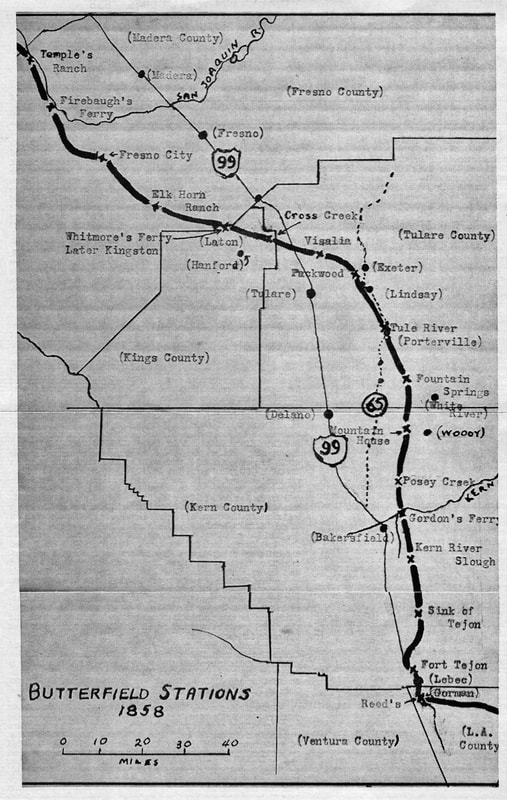
In Visalia, the Butterfield Overland Mail marker is on the north side of E. Main Street, just east of Court St. (and west of N. Church St.), near 116 East Main Street, at 36 19.814N, 119 17.523 W.
From Visalia, take Hwy 198 east to go south (right) onto Hwy 65 to Lindsay.
As you come to Lindsay, at the second stoplight, the intersection of Hermosa St. (Ave. 228) and Hwy. 65, turn right (west) and drive into the gas station on the corner on the south side of the street (235 N. Fremont Dr.). The Butterfield historic marker is just east of the gas station alongside Hwy 65 (at 36 12.148 N, 119 6.256 W; 36.203153, -119.105028), beside a marker for the Fremont Trail.
To see the big outdoor Butterfield mural nearby (at N36 12.198 W119.95.414), take W. Hermosa St. east (it will become E. Hermosa St.) to Elmwood Ave. Turn right [south] on Elmwood and find the mural south of Samoa St. and just north of Honolulu St. at 160 N. Elmwood.
Return to Hwy 65 and go south to Porterville. Take the Henderson Ave. exit east toward N. Main St. The marker is on the SW corner of the intersection with Sunnyside Ave. on your right in the small park dominated by the huge “Salute to the Farmer” statue (N36 04.788, W 119 01.188, 115 E 318132, N 3994687).
Now, go south to Fountain Springs. Proceed east on Henderson to turn south (right) onto N. Plano St. Follow Plano (it will become S. Plano and then Rd. 252) as it finally curves left and becomes Ave. 116. Follow Ave. 116 as it curves south (right) onto Rd. 264 (Old Stage Road) toward Fountain Springs and follow it to its junction with Ave. 56/J22 and Hot Springs Drive to read the historical markers there about Fountain Springs and the Old Stage Road. (Note that the actual Fountain Springs was about 1.5 miles northwest of this intersection.)
(To continue your drive through history, you may want to continue south on Old Stage Road [M-109] to White River and the Tailholt State Historical Landmark in Tulare County’s historic gold rush territory.)
To return to Visalia, go west on Ave. 56/J22 to Ducor and there go north (right) on Hwy 65 back to Hwy 198 west (left) back to Visalia.
(When leaving Visalia on its way to San Francisco, the Butterfield trail went west to approximately the present route of Hwy 99, where it turned north along that route at Goshen and traced it to about present-day Traver, where it turned west again, leaving Tulare County to cross the Kings River and head for Pacheco Pass.)