 Click on photo for more information.
Visiting the Dillonwood Grove and Dillon Mill Site in Sequoia National Park
by Laurie Schwaller
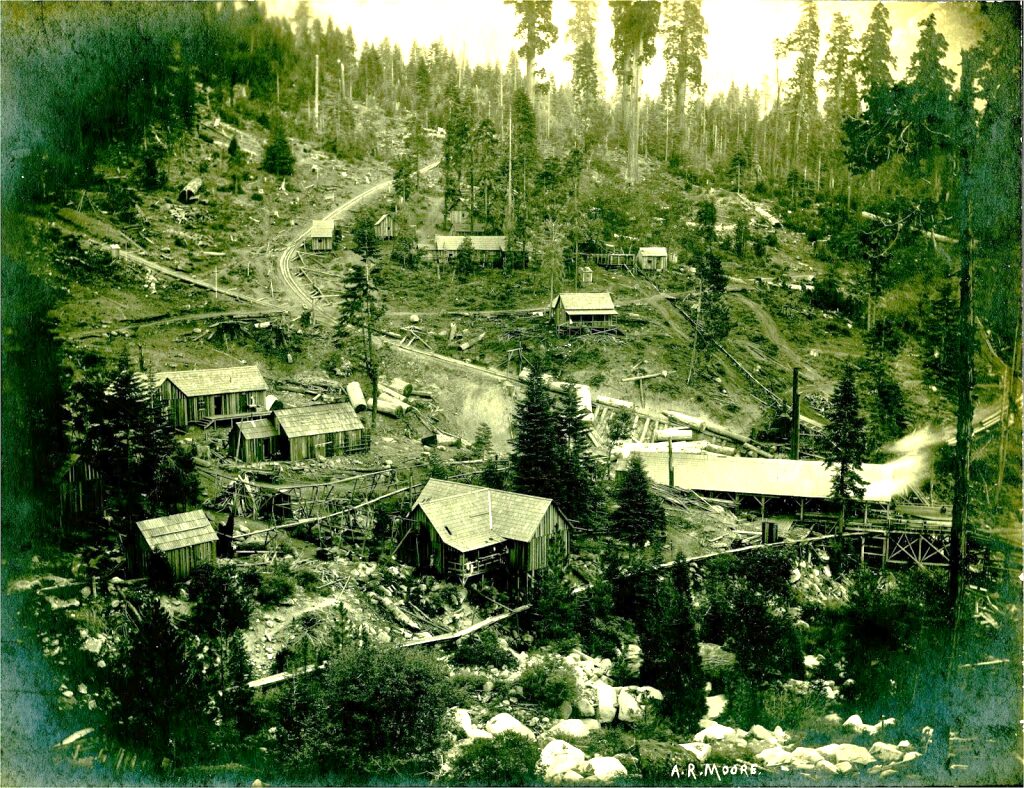
In 2001, the 1540-acre Dillonwood Giant Sequoia Grove and its historic Dillon Mill remains became part of Sequoia National Park, reuniting Dillonwood with its other half, the Garfield Grove, which had been protected in the park since its establishment in 1890. Straddling the north and south flanks of Dennison Ridge respectively, Garfield and Dillonwood comprise one of the five largest of all the Big Tree groves. But these two halves have very different histories: privately vs. publicly owned, logged vs. unlogged, almost unscathed vs. recently badly burned (NPS is planting restoration seedlings in the Dillonwood grove in 2025) — providing tremendous research opportunities and very different visitor experiences, with hope that Dillonwood may once again thrive anew.
November, 2025
NOTE: The Project Team will be conducting research for a full article as volunteer time allows. Contact us [INTERNAL LINK]if you’d like to help research, write about, and/or illustrate this Treasure!
NOTE: Dillonwood is hard to get to, and two extreme wildfires have destroyed almost all the remains of the mill structures and many of the trees, so you may want to delay visiting until some restoration results can be seen. You’ll need a high-clearance, 4-wheel-drive vehicle to navigate the mostly unmaintained Forest Road 19S09 (which may become impassable) toward the National Park’s closed gate, beyond which you’ll have to walk a few miles to get into the Dillonwood grove.
Contact Sequoia National Park for current conditions before planning your trip.
The shortest driving route to Dillonwood is via Yokohl Drive/M-296 to its junction with Balch Park Drive, but it’s probably faster to go the longer route through Springville:
From Visalia, go east on Hwy 198 to take Hwy 65 south (left) near Exeter. Exit Hwy 65 left (east) onto Rd. J28 toward Strathmore and Springville. When Rd. J28 reaches its junction with Hwy 190, turn east (left) to Springville. Go through Springville to turn north (left) just before the really big white barn on your left, onto Balch Park Dr./Rd. J37. At the junction with Yokohl Drive, stay right on Balch Park Dr., but do NOT follow Balch Park Dr./J37 when it turns sharply right toward Mountain Home Demonstration State Forest. Instead, go straight ahead on Rd. 276 until you quickly reach little-maintained Forest Road 19S09 on your right. This is where you’ll need high-clearance four-wheel-drive to get toward the Park’s locked gate, beyond which you’ll have to hike a few miles to get into what’s left of the Dillonwood Grove and the very few remaining fragments of Dillon’s mill.
Nearby Treasures: [8 INTERNAL LINKS] Mountain Home Demonstration State Forest, Balch Park, SCICON, McCarthy Blue Oak Ranch Preserve, River Ridge Ranch and Institute, Springville Historical Museum, Success Lake, Bartlett Park.