 Click on photo for more information.
Tulare Assembly Center-Temporary Detention Camp for Japanese Americans, California Historical Landmark #934.10
by Laurie Schwaller
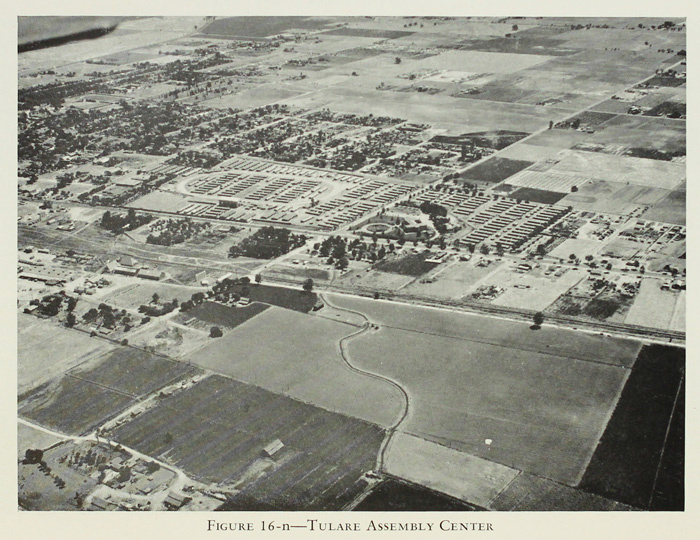
The Tulare Assembly Center at the Tulare County Fairgrounds (one of 16 Temporary Detention Camps for Japanese Americans) incarcerated almost 5,000 people in April-September, 1942. Most were then transferred to the hastily built Gila River concentration camp in Arizona and imprisoned there until autumn, 1945. (It was Executive Order 9066, issued in February, 1942, after Japan bombed Pearl Harbor, that a month later stripped of their rights about 120,000 persons of Japanese ancestry — 2/3 of whom were U.S. citizens — on the U. S. West Coast, followed by their forced imprisonment beginning in April.)
The military relocation order was finally rescinded in December, 1944, after the Supreme Court ruled that continued detention without cause was unconstitutional. The Gila River internees were released in phases, with the majority of the camp shut down in the fall of 1945.
While the Tulare Assembly Center (along with all the other temporary detention camps in California) was registered as a California Historical Landmark in 1980, the Tulare Center has never had a historical marker or any memorial erected at its site to commemorate and explain the unconstitutional continued detention without cause of the Japanese American internees in 1942.
Fortunately, that will change, as a group of history students at Tulare’s Mission Oak High School have been working for a number of years now to remedy this omission, with the Tulare County Fair Board’s approval and support.
The students’ ongoing efforts have already resulted in the creation of a 5’x8′ bronze bas relief sculpture by noted artist Sam Pena depicting internees arriving at the Center. It will be a major feature in the historical monument these scholars are planning to create and install prominently inside the fairgrounds’ main entrance. Amid Japanese garden-inspired landscaping, the memorial will include informational panels and bronze plates naming all those who were incarcerated in the Tulare Assembly Center.
The hundreds of thousands of diverse visitors to the fairgrounds’ events annually will be met and enlightened by this arresting display. And the monument will also focus a long-range educational program with local schools and the Tulare Historical Museum to continue the students’ mission to increase awareness and understanding of what happened here in 1942 — so that we will Never Forget that something like this must never happen again in our nation.
January, 2026
NOTE: The Project Team will be conducting research for a full article page as volunteer time allows. Contact Us if you’d like to help research, write about, and/or illustrate this Treasure!
Address: 620 South K Street, Tulare, CA
From Visalia, take Hwy 198 west to go south onto Hwy 99 south to Tulare. Exit onto E. Bardsley Ave. going west right). Then go north (right) on South “K” Street, to 620 South “K” Street. The fairgrounds are on your right.
NOTE: The Tulare Assembly Center, although registered as a California Historical Landmark in 1980, has never had a historical marker or any other memorial erected at its site, so visitors as of 2026 can see only the fairgrounds. Meanwhile, a group of history students at Tulare’s Mission Oak High School have been working (researching, meeting, interviewing, designing, speaking, fundraising) for several years to create and install a monument inside the fairground’s main entrance. Their planned monument MIGHT be in place by the end of 2027, depending on when a major remodeling of that area of the fairgrounds is completed.
Nearby Treasures: Tulare Historical Museum, Tulare Union High School Auditorium (check open days and times before you go).