 Click on photos for more information.
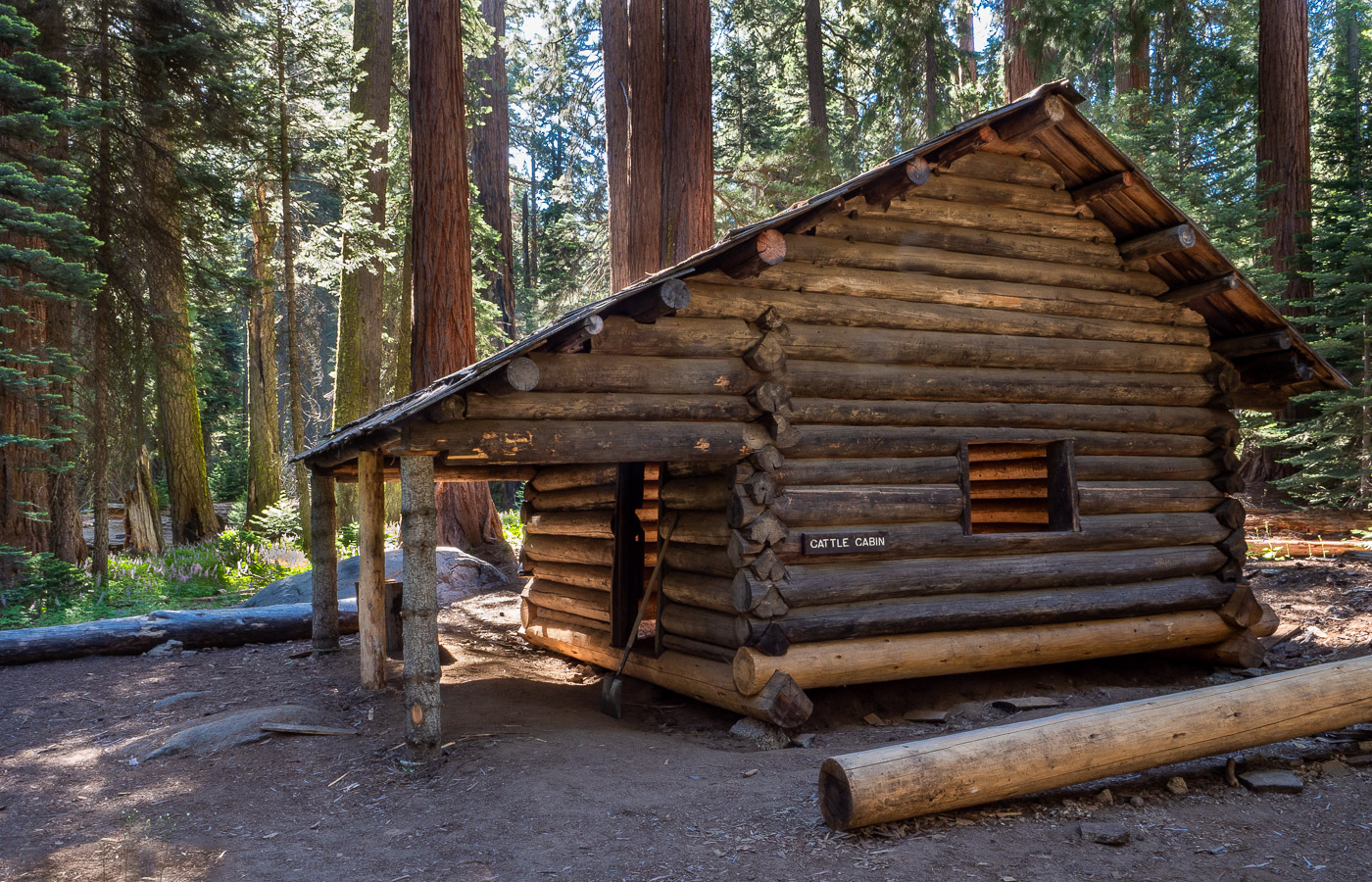
Visiting the Cattle Cabin in Sequoia National Park
by Laurie Schwaller
Find the historic Cattle Cabin in Sequoia National Park’s Giant Forest, just south of the majestic Founders Group on the scenic Circle Meadow Trail. This simple, sturdy shelter recalls the many years when foothill ranchers, beginning with Hale Tharp, in 1861, drove many hundreds of cattle here annually for summer grazing, and eventually added dairy operations — and a Circle Meadow slaughtering corral, to supply fresh milk and meat to the growing populations of workers and tourists thronging the Forest. Can you imagine those days in the timeless, irreplaceable landscape surrounding you today?
October, 2025
NOTE: The Project Team will be conducting research for a full article as volunteer time allows. Contact us if you’d like to help research, write about, and/or illustrate this Treasure!
From Visalia, go east on Hwy 198 through Three Rivers to the Sequoia National Park entrance station (fee), where Hwy 198 becomes the Generals Highway. Continue up the mountain on the Generals Highway to just before the Giant Forest Museum, where you will turn right onto the Moro Rock/Crescent Meadow Road. Follow this road (bearing left where the road to Moro Rock bears to the right) to the Crescent Meadow parking lot and the trailhead at the end of the road.
(NOTE: Crescent Meadow Rd. may be closed in peak season (typically mid-May to mid-September) to automobile traffic; if so, you can catch the Gray Route 2 shuttle to Crescent Meadow).
SEE trail directions and partial trail map below:

Take the Crescent Meadow trail on the left (west) side of Crescent Meadow and go north to the first trail junction, where you’ll go left (not right toward Log Meadow). At the next junction, go right (north) toward Circle Meadow. Keep right again at the next junction, then go left at the ensuing junction to proceed north on the Circle Meadow trail and find the Cattle Cabin on your right, about 1.4 miles from your starting point.
Alternatively, you can hike to the Cattle Cabin from the General Sherman Tree, if you’re visiting that grandest giant sequoia. Find the nearby Congress Trail trailhead just to the east of the General and follow it south toward the Founders Grove; you’ll see many sensational sequoias on your way to the Cattle Cabin at Circle Meadow.
Nearby Treasures: Squatters Cabin, at the northeast edge of Huckleberry Meadow; Tharp’s Log, near the northwest edge of Log Meadow; Moro Rock Stairway, just a short loop drive off the Crescent Meadow Road.