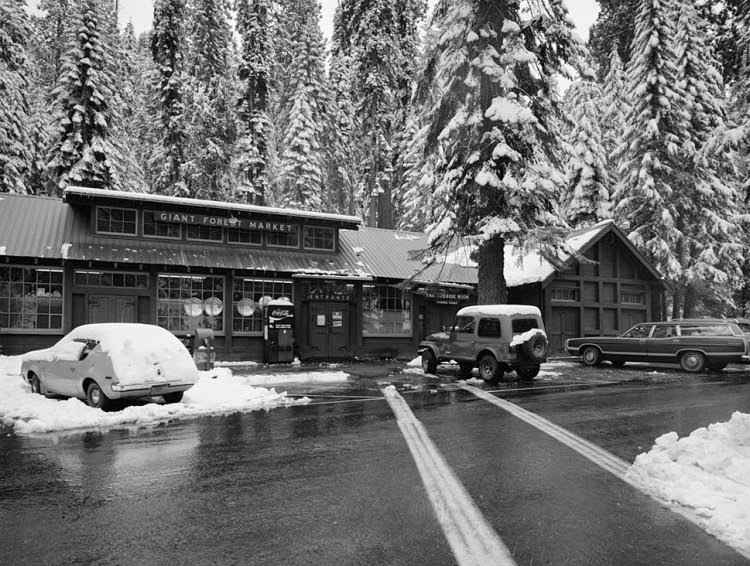
 Click on photo for more information.
Giant Forest Historic Districts
by Laurie Schwaller
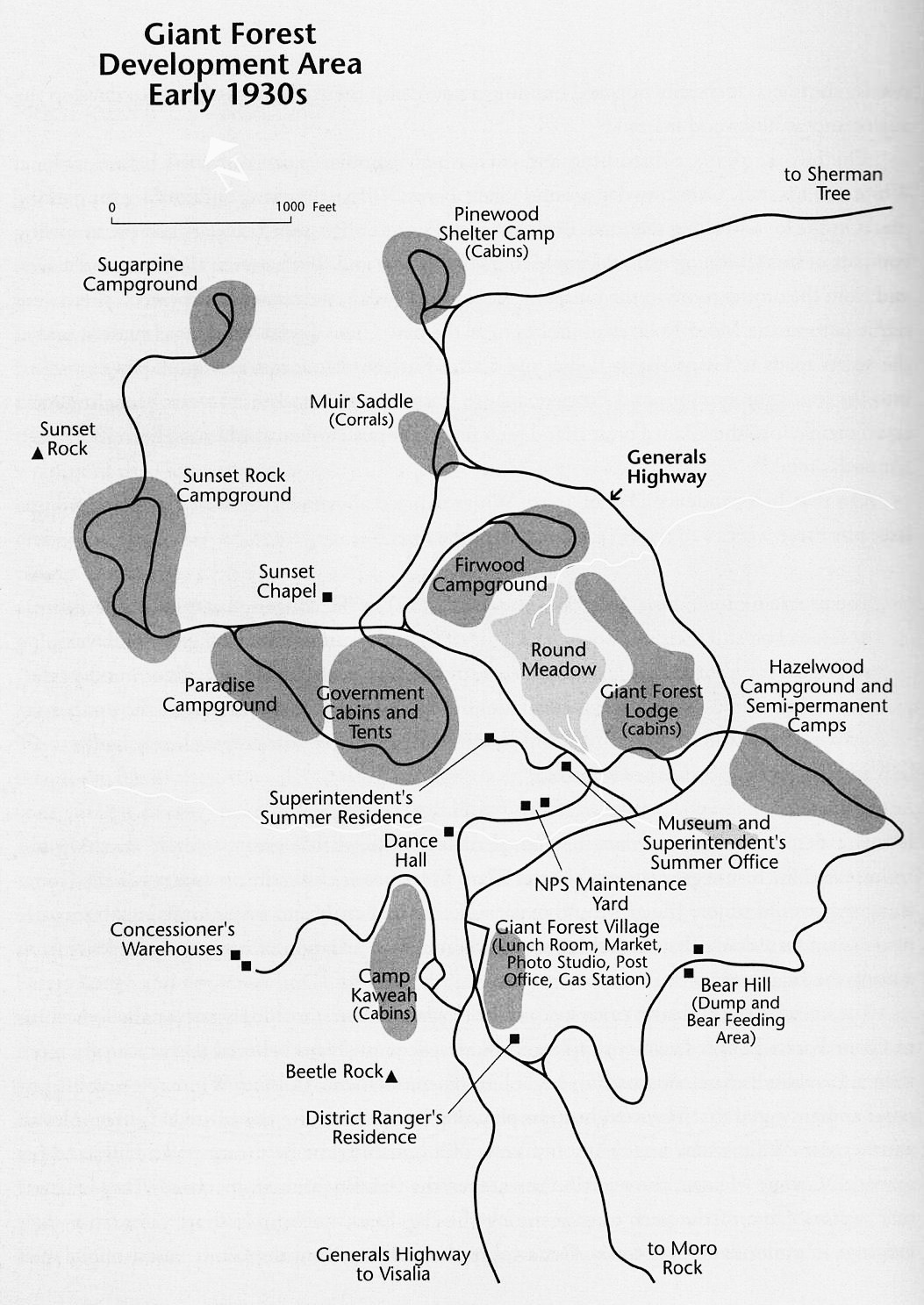
At their peak, in about 1940, Sequoia National Park’s concessionaire’s historic Giant Forest Lodge, Camp Kaweah, and Giant Forest Village had spread 400+ structures through a large part of the Giant Forest. continually increasing tourism and the concessionaire’s interest in building still more. In 1978, the Park qualified 71 of the most architecturally, culturally, and historically significant of these buildings for listing on the National Register of Historic Places.
But two years later, the park’s 1980 Development Concept Plan officially addressed the incompatibility of the sprawling facilities with the health and meaning of this world-famous forest that the Park had been created to protect. The plan proposed removing from the Giant Forest all of these structures, along with the neighboring Park-provided campgrounds, and all the roads and other infrastructure connecting and servicing these attractions and accommodations. The Park’s concessionaire, many Tulare County and Valley residents, and others from much farther away, decried the Park’s plan and the prospective loss of the beloved facilities that had hosted so many of them for decades.
It took almost two decades of preparing and presenting more detailed plans and alternate plans, public and private meetings, difficult negotiations, the siting and construction of new facilities outside of the Giant Forest, and years of hard physical and mechanical labor, but by 1999, only three of the historic structures remained. Virtually all the rest of the evidence of the many decades of development was gone, enabling the restoration of the Giant Forest we treasure today to begin.
And those three surviving structures? They’re still in use today. The Giant Forest Market, designed by renowned architect Gilbert Stanley Underwood, and built in 1928-1929, was extensively remodeled inside, to become the welcoming and enlightening Giant Forest Museum. The nearby comfort station (nowadays generally called “restroom”) still stands in service next to the Museum. And just a short walk away, and a little uphill, the iconic ranger residence continues to house park rangers.
These timeless examples of Parkitecture, constructed with native materials — wood and stone, and of a size and shape and coloring to blend and harmonize with their natural surroundings, are as attractive and admired today as they’ve been for nearly a hundred years already. Inside the Museum, you can learn when, where, why, and how all these momentous changes occurred in the life and character of the world’s irreplaceable Giant Forest. Then walk the Big Trees trail circling nearby Round Meadow and see what you think about the results.
November 2025
NOTE: The Project Team will be conducting research for a full article as volunteer time allows. Contact us if you’d like to help research, write about, and/or illustrate this Treasure!
From Visalia, go east on Hwy 198 through Three Rivers to the Sequoia National Park entrance station (fee), where Hwy 198 becomes the Generals Highway.
Continue up the mountain on the Generals Highway to the Giant Forest Museum (formerly the Giant Forest Market), on your right. Park in the big lot across the road on your left and you’ll be able to easily walk to the only three remaining structures of the hundreds that thronged the Giant Forest by the 1940s.
If you can, take the time to walk the all-accessible trail around Round Meadow, and the trail out to Sunset Rock. Imagine what your experience would be if this forest were still filled with roads, cars, shops, motels, cabins, campgrounds, signs, litter, trash cans, artificial lights, outdoor cooking, cacophonous radios, wires, poles, parking lots, many beaten paths, and wildlife jonesing for snacks.
Nearby Treasures: Moro Rock Stairway is just a short loop drive down the Moro Rock/Crescent Meadow Road, starting at the west end of the parking beside the Museum. Tharp’s Log and the Squatter’s Cabin are two lovely walks away from the Crescent Meadow parking lot/trailheads.