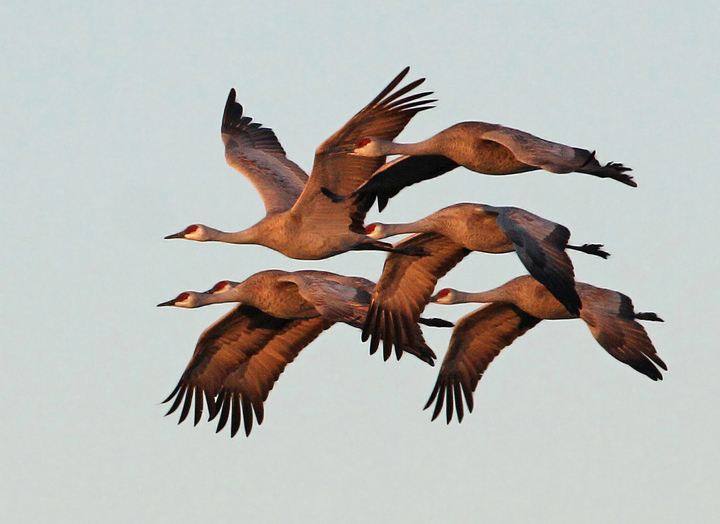
Click on photos for more information.
The Story of Pixley National Wildlife Refuge
by Nancy Bruce
For hundreds of millennia, Tulare Lake’s vast wetland ecosystem supported a rich tapestry of life, strongly woven and resilient to the variations in climate and fluctuations of water availability. It provided essential winter habitat for tens of millions of migrating birds and abundant wildlife such as Tule elk, pronghorn antelope and grizzly bears. For at least ten thousand years, Yokuts and their ancestors hunted and fished from the tremendous bounty of these freshwater wetlands. Reports of the sky being darkened overhead by the enormous flocks of migrating waterfowl came from Yokuts and early non-native settlers alike.
By the late 1800s, however, California’s growing population began to transform the landscape. Settlers living along the upstream tributaries began digging ditches to divert water for growing wheat and barley, diversifying to other crops as irrigation systems were developed. Tulare Lake and its surrounding wetlands dwindled as tule marshes were drained and reclaimed as farmland.
A seemingly inexhaustible wealth of water supported the expansion of Central Valley farming communities in the last two decades of the 1800’s. Artesian wells irrigated the semi-arid land in Pixley, Tipton, and Tulare. But by the early 1900s, these wells dried up, and farmers began drilling deeper wells and pumping ground water to nourish crops. The once-vast wetlands shrank and shriveled as farm operations increasingly diverted water from the Kaweah, Tule, and Kern rivers until Tulare Lake, once the largest body of fresh water west of the Mississippi, was gone.
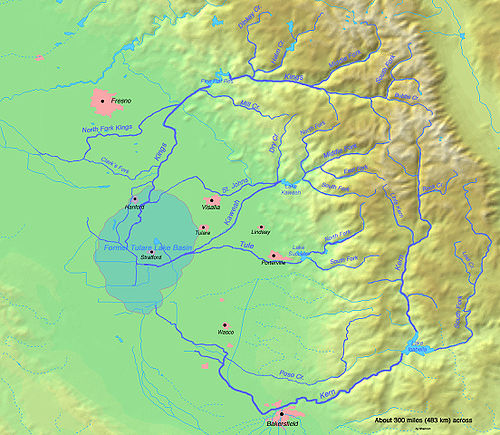


As the great lake and its ecosystem dwindled away, so did the huge flocks of ducks, geese, and cranes that had wintered there. Alarmed at this loss, local sportsmen formed duck clubs, private organizations of hunter-conservationists dedicated to preserving wetlands for continuing the tradition of waterfowl hunting; and so, in the 1920s, a resurgence began. The clubs bought or leased tracts of marginal agricultural land and flooded them in the fall to create wetlands that attracted birds. In spring, the land dried, creating fields in prime condition for cattle grazing. For many years, duck clubs were the sole provider of wetland habitat for over-wintering waterfowl in the Tulare basin.
Meanwhile, by around 1930, the highly alkaline soils in the Pixley area were proving unfit for agriculture, forcing numerous homesteaders to abandon their 160-acre tracts. When this non-productive farmland reverted to the government, it was retired from agriculture and placed under the management of the United States Forest Service. These changes created a profound opportunity for bringing back what had been lost.
Momentum built as scientists and ordinary citizens began to recognize the importance of providing places for waterfowl to take up winter residence or stop to rest along this inland portion of the Pacific Flyway — an avian superhighway that stretches from northern Canada’s summer breeding habitats south to Mexico.
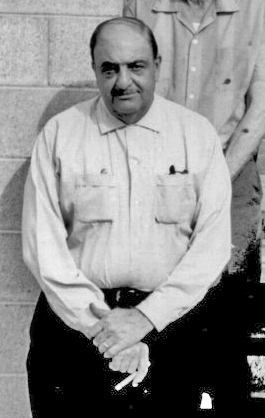
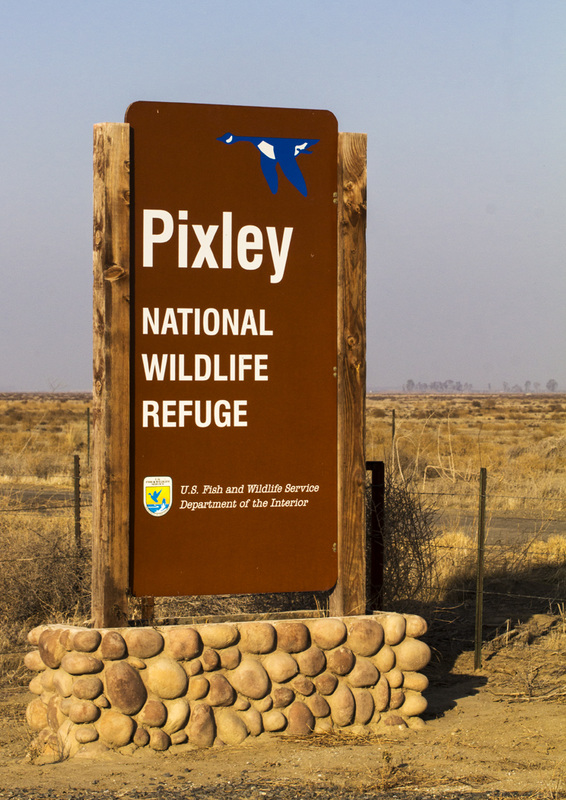

Outspoken J. Martin Winton, who grew up hunting in waterfowl- rich wetlands of Tulare Basin, became an enduring advocate for protection of this vanishing habitat. Local interest grew for creation of a waterfowl refuge in the southern Central Valley. Sportsmen supporting the refuge included State Fish and Game warden Joe Burnett of Tulare; Eldon Ball, Superintendent of Sequoia National Park; and Judge O.W. Bryan of Pixley. In January, 1957, Tulare resident Zaven Egoian approached the Tulare County Board of Supervisors and won their support for a waterfowl management area in the worn out farmlands outside of Pixley. Less than three years later, Pixley National Wildlife Refuge (NWR) was created by Federal action, on November 17, 1959, to be administered by the U.S. Fish and Wildlife Service under the Migratory Bird Conservation Act for the benefit of migratory birds and other wildlife.
Now all that prevented the recovery of wetlands and waterfowl at Pixley NWR was lack of a reliable water source. With no water and no waterfowl, attention turned to expanding the refuge’s Valley Grassland habitat—its plant communities, native songbirds, and wildlife. Over 2,200 acres of additional grasslands were acquired in an effort to support populations of three threatened or endangered species living there: the Tipton kangaroo rat, the blunt-nosed leopard lizard, and the San Joaquin kit fox. Grasslands thrive with appropriate grazing levels, so cattle grazing was—and continues to be—used as a tool to maintain healthy upland habitat.
Finally, Pixley NWR was granted a permanent allocation of water from the Friant-Kern Canal as part of the Central Valley Project Improvement Act of 1992. Unfortunately, no suitable canals or pipelines connect the refuge to its water source.


Then Ducks Unlimited (DU), an organization of duck hunters dedicated to increasing waterfowl populations nationwide, stepped up to help make refuge wetlands a reality. In partnership with the refuge, DU acquired grants to drill a deep well as an interim water source and create wetland basins contoured to meet the needs of waterfowl. In autumn of 1994, the first water flowed out to flood the basins and revive the wetlands.
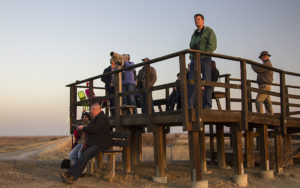
The water brought increasing populations of migrating waterfowl to rest and feed at Pixley. But the refuge had no infrastructure for public access until Barbara Hopkins, then Tulare County Audubon Society president, became desperate to view her first-ever Fulvous Whistling Duck. As she ducked under the barbed wire perimeter fence and hurried along the levee with her spotting scope, Nick Stanley, the Refuge manager, observed her intrusion and approached in his pickup truck. When he confronted Barbara with her trespassing, she fired back, “Well, you should consider giving the public access to this place.” And so a nature trail and viewing platform were born, built by volunteers from Tulare Audubon and opened to the public in 2001.
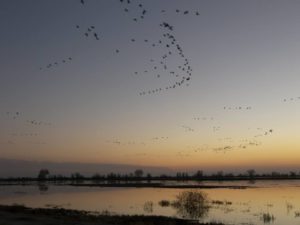
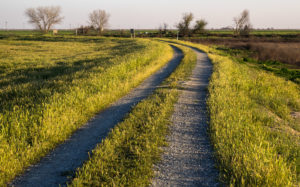
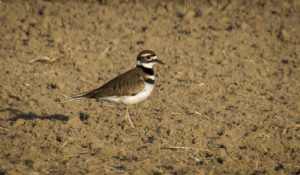
Today, from the public parking lot, the half-mile nature trail, and the viewing platform, you can watch dynamic flocks of ibis swoop into flight over fields of emerald and gold. When an approaching falcon stirs the flock, you’ll hear the thrumming wing beats of thousands of ducks taking off from grasslands and wetlands, and the cacophony of ducks, geese, and cranes conversing. Come an hour before sunset in fall and winter to experience the thrilling evening fly-in, when the glowing sky fills with skein after skein of calling wildfowl seeking refuge for the night. And as you marvel at this vital habitat and its wonderfully diverse populations of birds, plants, and animals, you can thank the tenacity of life itself and the persistence of dedicated individuals— ranchers, hunters, scientists, farmers, bird watchers, and wildlife enthusiasts—working together for the common goal of conservation.
October, 2014




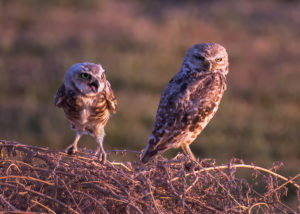
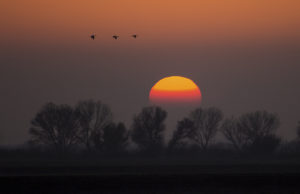
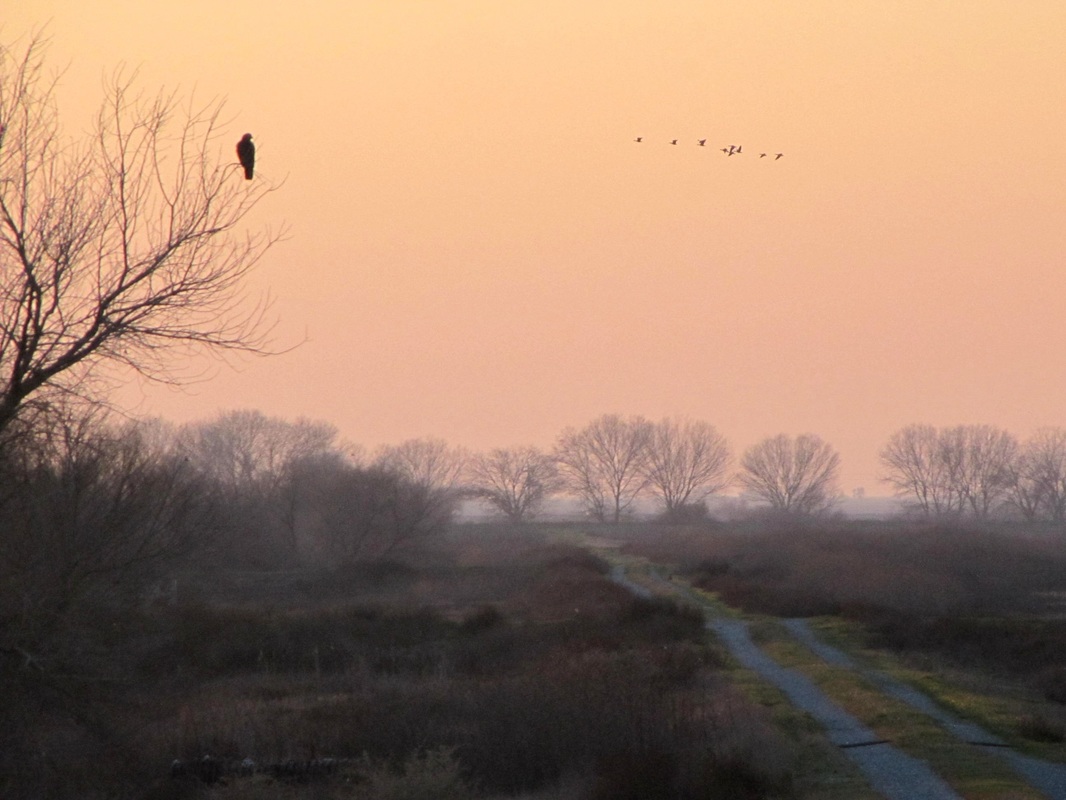
“In a world older and more complete than ours [animals] move finished and complete, gifted with extensions of the senses we have lost or never attained, living by voices we shall never hear. They are not brethren, they are not underlings; they are other nations, caught with ourselves in the net of life and time, fellow prisoners of the splendour and travail of the earth.”– Henry Beston
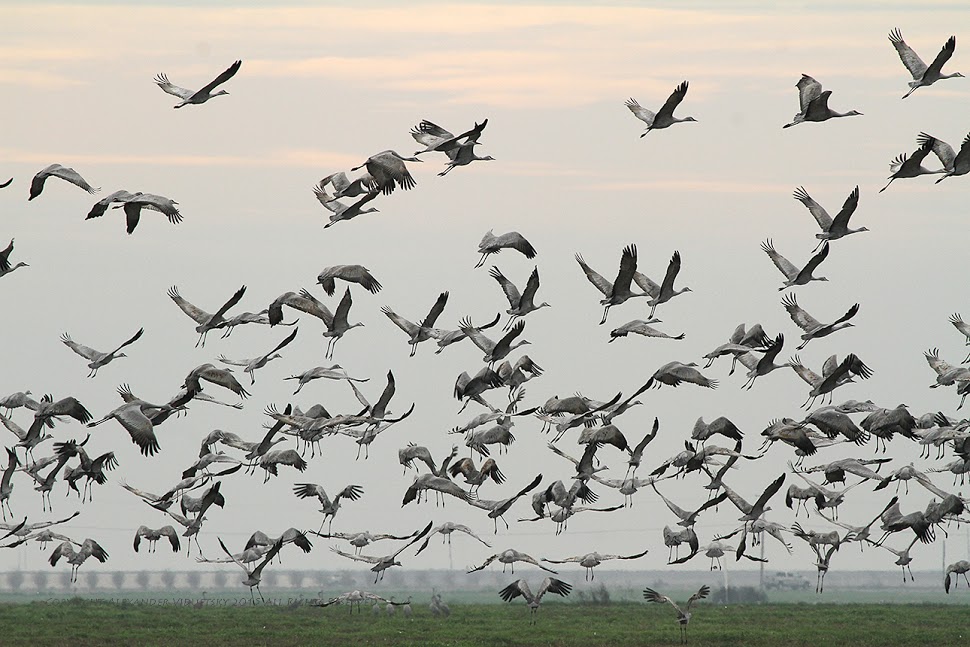
“Migrating waterfowl blackened the skies. Grizzly bears prowled the forests. Vast herds of deer, pronghorn antelope, and elk . . . thundered across the plains.” — Philip L. Fradkin

“We crossed an arm of the lake and landed on a small wooded island . . . . There were birds in almost incredible numbers — ducks, geese, swans, cranes, curlews, snipes, and various other kinds . . . and eggs by thousands . . . . ” — James Capen Adams, 1911

“There is symbolic as well as actual beauty in the migration of the birds . . . . There is something infinitely healing in the repeated refrains of nature – the assurance that dawn comes after night, and spring after the winter.” — Rachel Carson

“[T]he real stars of the show were the sandhill cranes, their wild, primitive chortle echoing up and down the valley . . . .” — Gary Ferguson

“[C]ranes have been around since the Eocene, which ended 34 million years ago. They are among the world’s oldest living birds and one of the planet’s most successful life forms. . . . The particularly successful sandhill crane of North America has not changed appreciably in ten million years.” — Alex Shoumatoff

“Dance is one thing cranes are credited by many societies with giving us. Another is language, perhaps because they are so vocal and a single crane’s calls . . . can carry a mile. [C]ranes fly in loose, drifting, chimeric lines that are constantly, kaleidoscopically coming apart and forming, the ancient Greeks imagined, many letters. Crane hieroglyphs were applied to the Temples of Karnak 4,000 years ago.” — Alex Shoumatoff
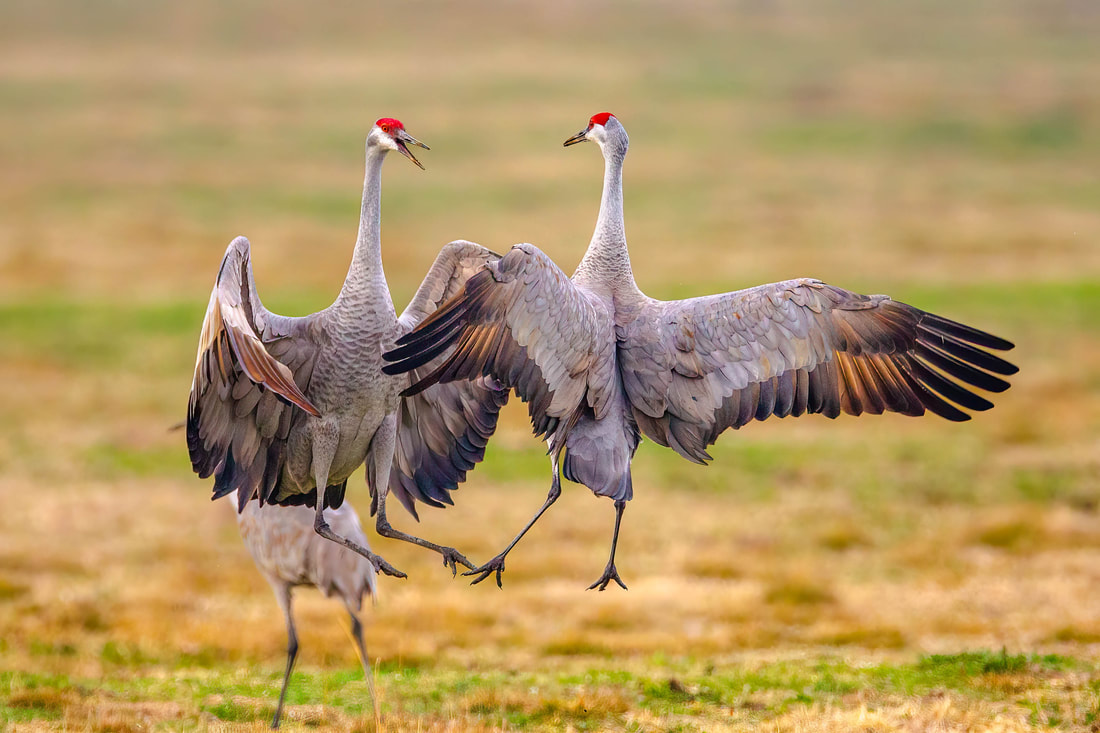
“For the Greeks, and later the Romans, the dance of the cranes was said to be a celebration of the joy of life.” — Gary Ferguson

“Ranging in height from three to four feet, they are moving on black stiltlike legs (their ‘knees’ are modified heels, so they actually walk on their toes), with their necks bent down, stabbing at the stubble with long daggerlike beaks, flipping cow pies, crunching up insects, snails, frogs and snakes.” — Alex Shoumatoff

“We feel that we are in the presence of something extraordinary, the abundance that was once everywhere.” — Alex Shoumatoff
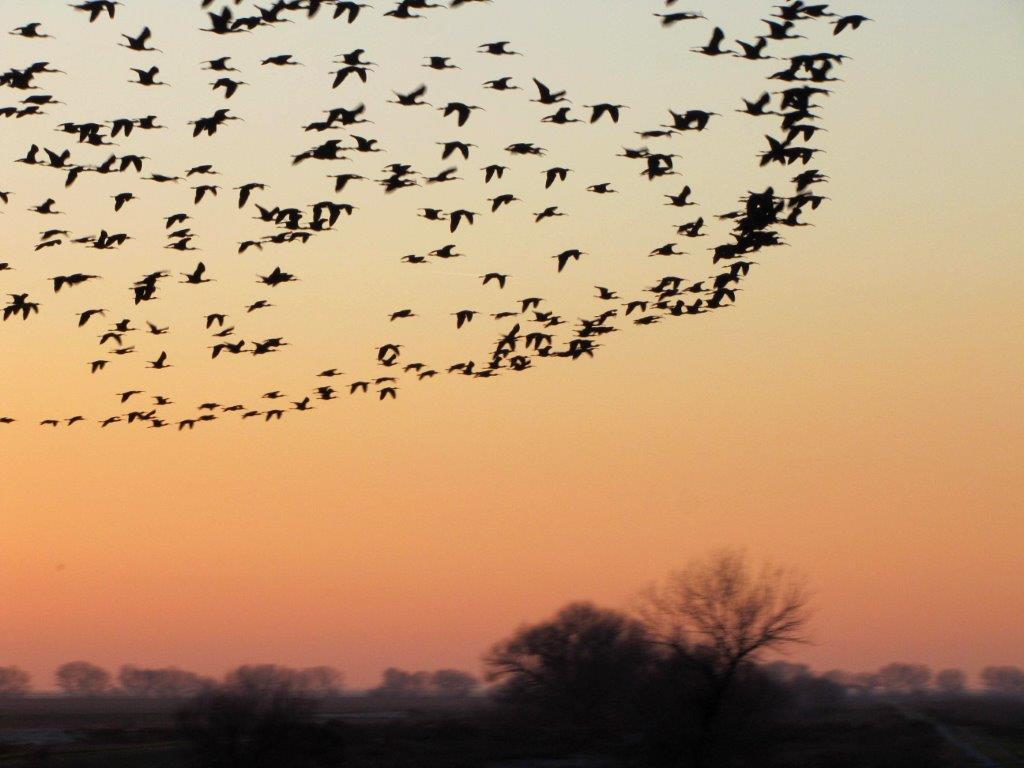
“Before the cranes fly in, White-face Ibis arrive by the thousands, often forming dense black clouds of birds before funneling into the marsh. Ibis with their down-turned impressive bills are bronzy-colored long-legged wading birds of fields and marsh. Immediately after these dark waders settle into their night roost, lines of cranes from all directions fill the horizon, announcing their approach with their loud bugling calls.” — Tulare County Audubon Society

“Hearing and seeing 8,000 Sandhill Cranes descend into the marshes of the Pixley National Wildlife Refuge (NWR) at sunset is certainly one of the premiere nature events in Tulare County as well as all of California. This is a must-see show for every Tulare County resident.” — Tulare County Audubon Society
Directions:
Address: Road 88, Pixley, CA 93256;
From Visalia, take Hwy 99 south. At Earlimart, take the Avenue 56 exit (Sierra Ave.) and go west 5.7 miles. Just before Road 88 is a small sign directing you to the Refuge; turn north (right) onto Road 88. In about 1 mile, cross a small ditch (Deer Creek). Immediately after the ditch, and to the west (left), is a gravel parking area and the trailhead. Trail guides are available in the box near the information sign