Click on photos for more information.
A Tale of Two Post Offices: the Porterville Main and the Visalia Town Center POs
by Laurie Schwaller
While some post offices today may not be seeing the traffic they once did, two Tulare County post offices — the Porterville Main and the Visalia Town Center — are definitely worth a visit. Both buildings are honored on the National Register of Historic Places, and both can easily be explored in a single day for a memorable double dose of artistry and history.
Both feature distinctive architecture; timeless, eye-catching aesthetics; and high-quality construction. They’ve served their communities continuously since 1934 and are still going strong. Built during the hard times of the Great Depression, they provided jobs, services, faith in the future, and even a touch of glamour when these were needed most.


America had been riding high on a wave of technical and industrial progress before the stock market crashed in 1929, followed by the onset of the Dust Bowl in 1930. By 1932, one in four American workers was unemployed. Tens of thousands of immigrants were streaming from other states into the San Joaquin Valley, desperately seeking work, affordable land, and a way to feed their families.
In 1933, President Franklin D. Roosevelt responded to these crises by greatly expanding the nation’s public works programs begun by his predecessor, Herbert Hoover, creating jobs across the country to build significant, durable public facilities that included over 1,000 post offices, Porterville’s and Visalia’s among them.
Renowned Fresno architects designed these two post offices in the Streamline Moderne style, typifying much government architecture of the thirties. The buildings’ classical, symmetrical proportions reduced design and construction costs while projecting a much-needed sense of stability and continuity.


While these seem at first glance to be fairly simple buildings, their details are striking. Their use of modern, man-made materials such as etched glass, aluminum, chrome, and stainless steel reflected the nation’s burgeoning industrialism and brash confidence during the 1920s, and foretold a brighter future ahead. Art Deco geometric and nature motifs included plant, flower, and sunrise themes to simultaneously evoke growth, vigor, and renewal.
H. Rafael Lake designed the Porterville post office. Its construction began in January, 1933, and was completed that November. The doors opened for business on January 2, 1934. Considered the town’s most sophisticated Art Deco structure, it was also Porterville’s last building with the basement dug by mules and a scraper. Now it is one of only three overtly Art Deco post offices remaining in California.
A Tour of the Porterville Main Post Office
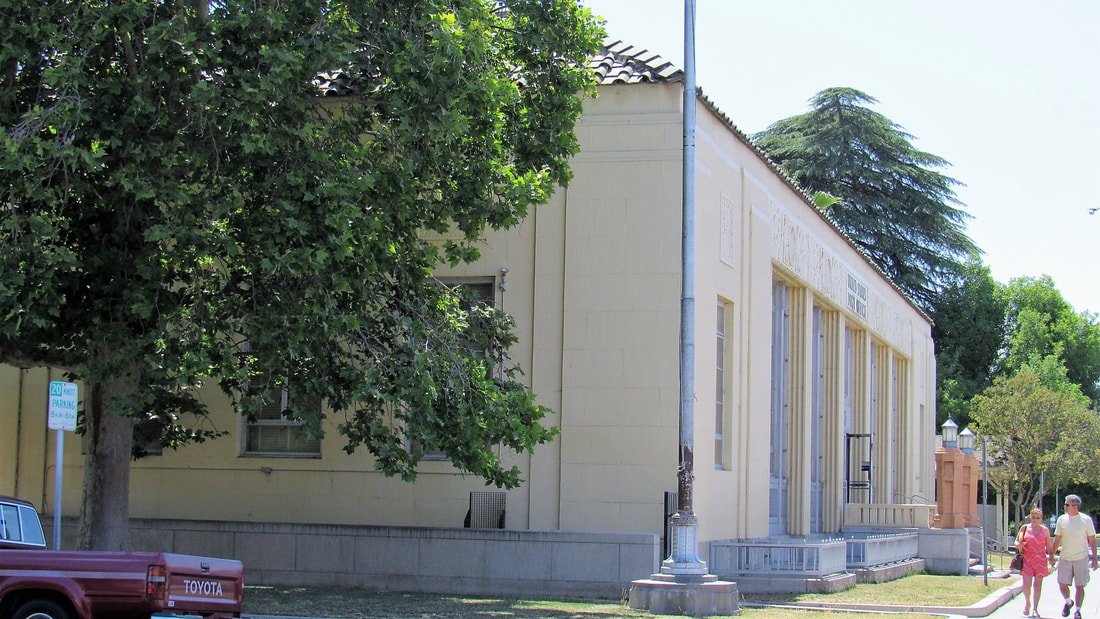
Note the two Art Deco columns flanking the steps leading to the front doors. The columns’ deeply carved designs echo the vertical piers and geometric and organic forms on the wall ahead, and these are reflected again in the etched glass and aluminum frames of the lantern atop each column.
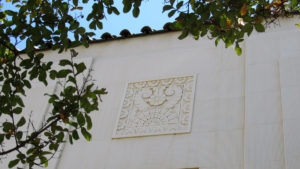
The grooved, vertical concrete piers on the front of the building hint at classical architecture’s columns and hold up a long horizontal frieze of strong, stylized federal eagles. Borders of curving Art Deco forms suggest thriving foliage and rising suns or the regenerative centers of flowers.


The big north-facing windows are framed in bright polished aluminum, with cast aluminum panels below depicting forms like fern fronds about to unfold. In the panel above the entry doors, a circular leaf pattern points upward on either side. Beautiful bas relief panels on the east and west end walls of the post office reiterate these encouraging themes.


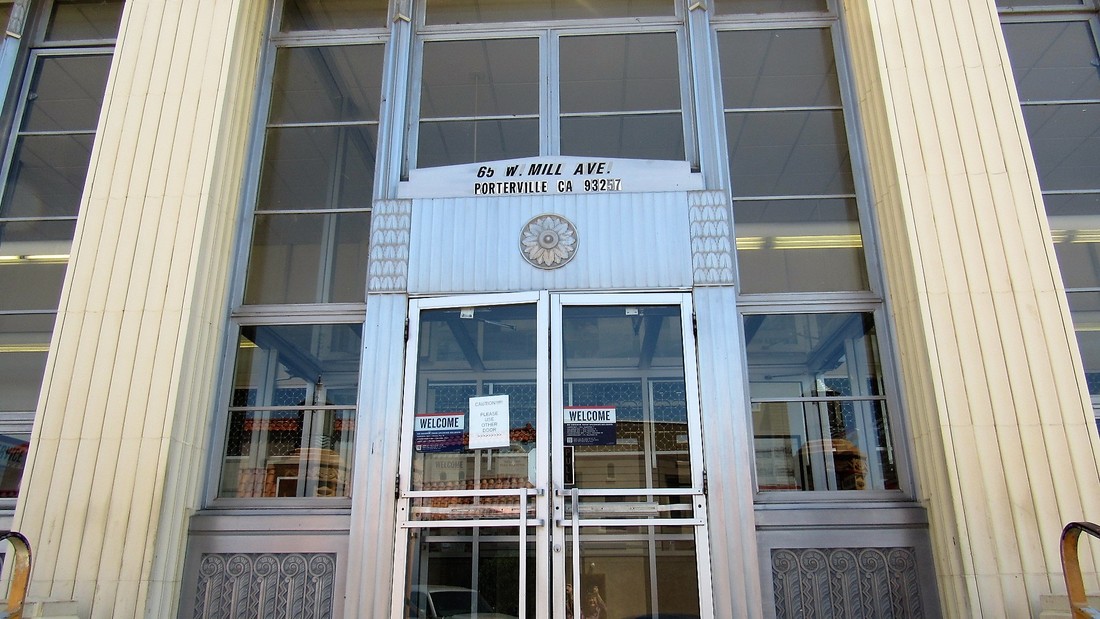
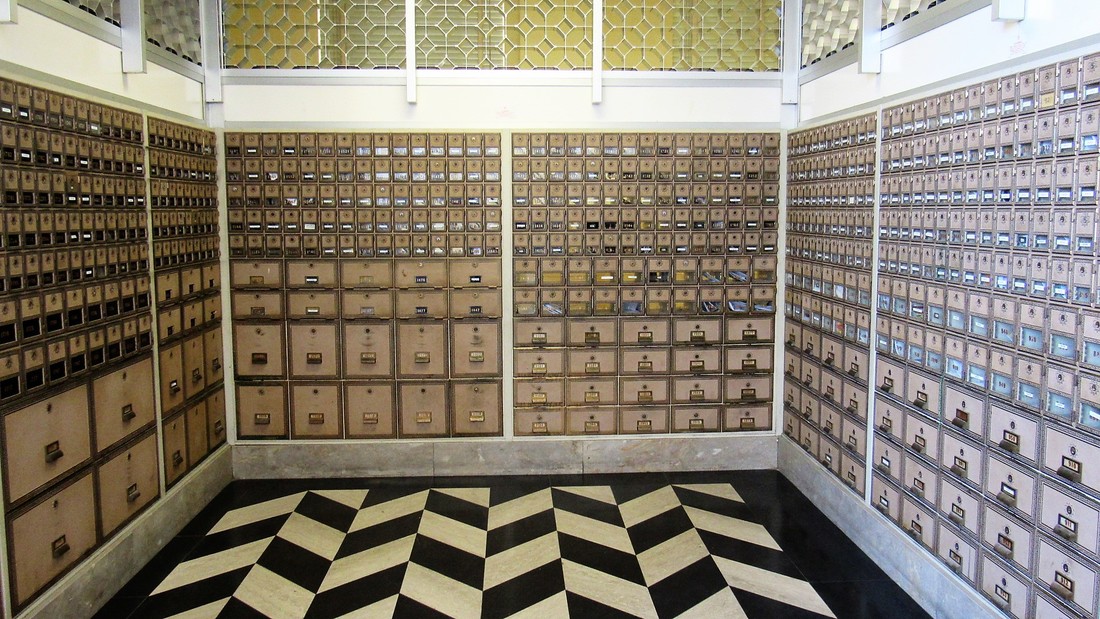
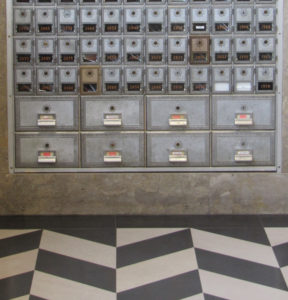
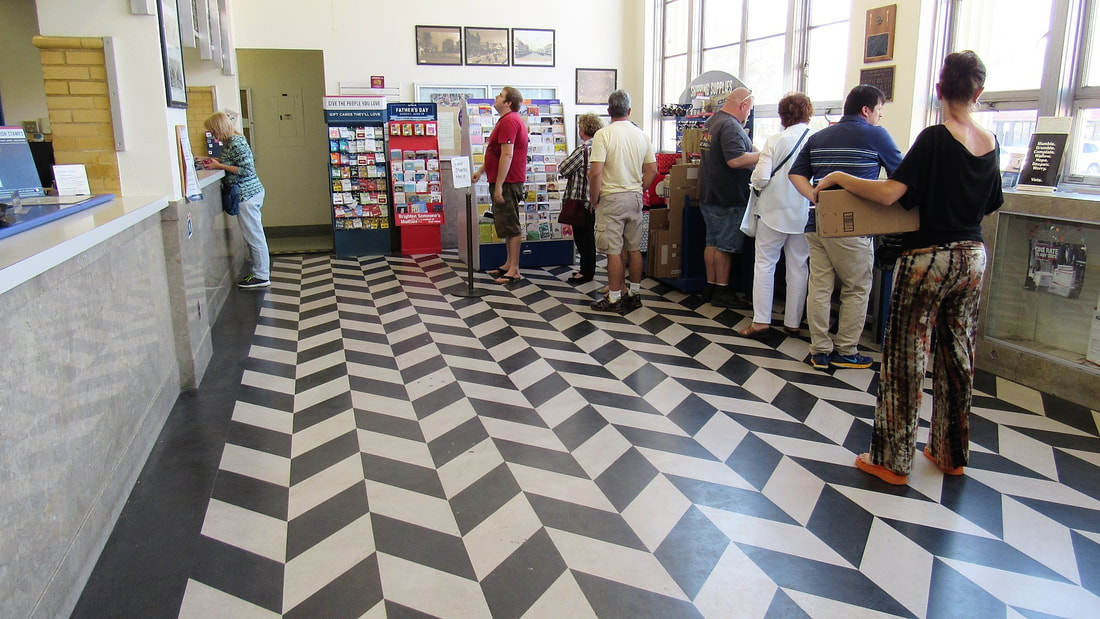
Bright grooved aluminum panels frame the double doors, echoing the grooved columns, while cast aluminum letters above spell out the name of the post office. Inside, a lively black and white zig-zag patterned marble floor runs the length of the building, from the service area on the right, to the room housing the hundreds of individual metal post boxes on the left. Decorative aluminum grillework rises from the boxes to the ceiling, and traditional marble wainscoting lines the walls.
Near the service windows, framed historic photos depict the construction of the post office. It was built in less than a year, but with meaningful materials that brought together the past and the future, and highly-skilled design and workmanship that have withstood the tests of time and changing tastes.


Before leaving this landmark, you may want to take a few photos, so that you’ll be able to compare Porterville’s post office with Visalia’s when you get there.

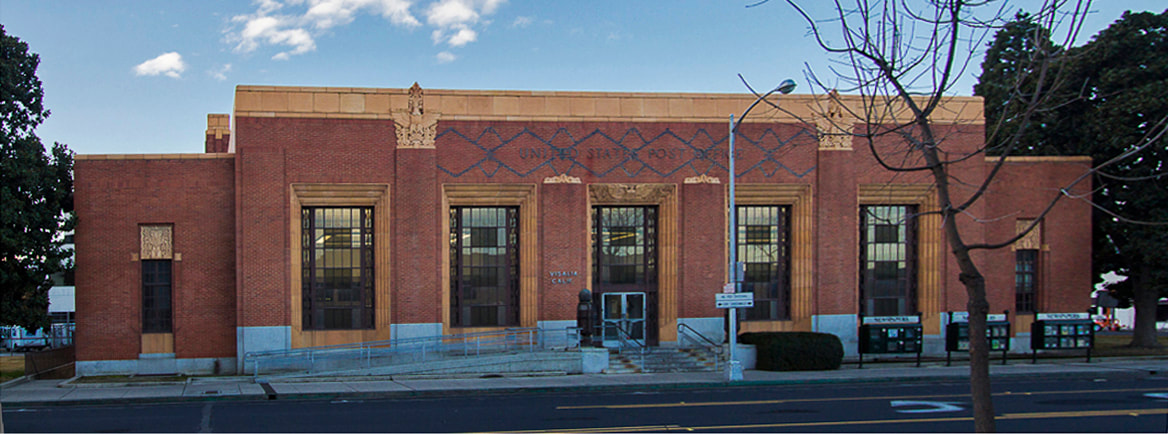
The Visalia Town Center Post Office was designed by William D. Coates, Jr., California’s State Architect from 1909-1911. Coates designed many significant buildings in this area, including high schools in Fresno, Hanford, and Porterville; the original Porterville fire station, and Bartlett Middle School in Porterville.
His outstanding plan for this post office resulted in “the clearest statement in monumental Art Deco architecture applied to any public building constructed in California, . . . one of the most aesthetically successful post offices in California, and . . . one of the most sophisticated buildings in Visalia,” per the National Register.
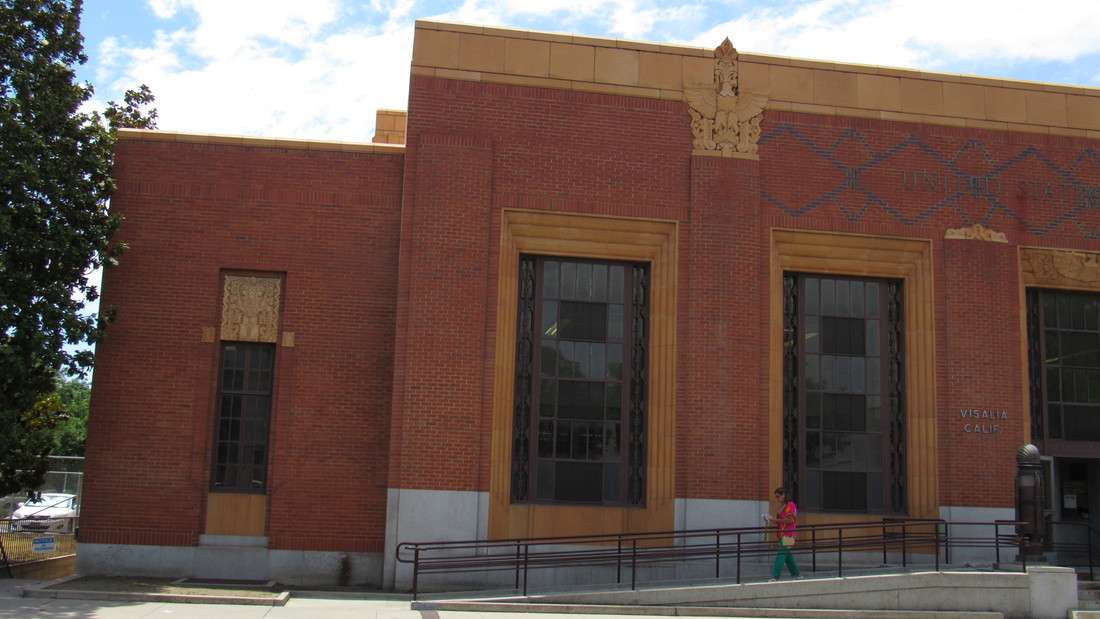
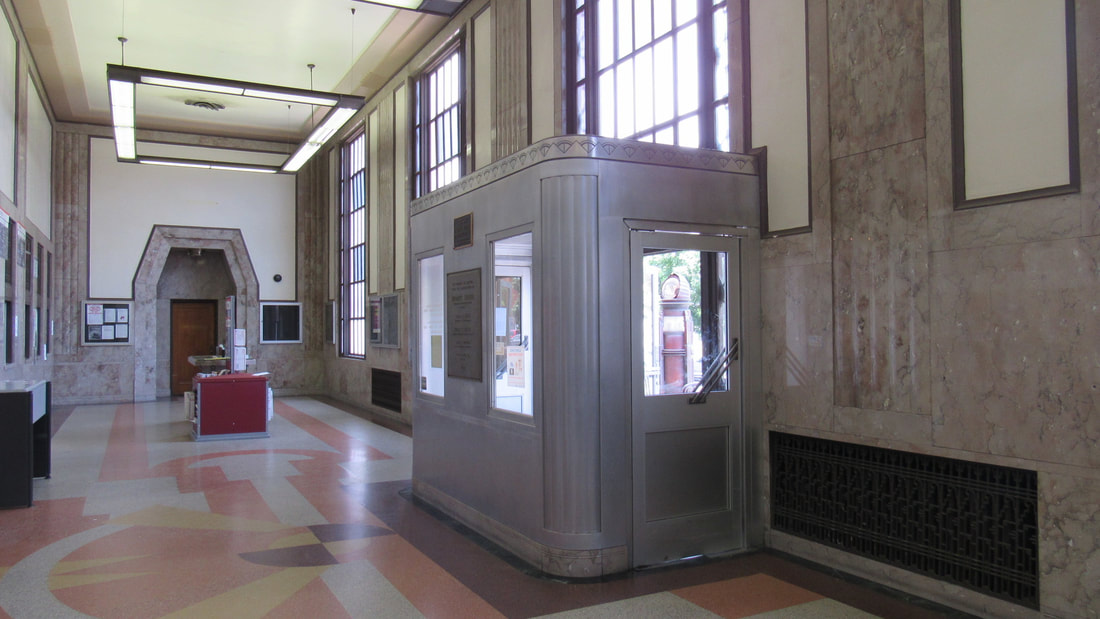

With blueprints completed in 1932, construction began in 1933, and the new post office opened to the public on July 30, 1934. While at first glance Visalia’s post office looks very different from Porterville’s, there are many similarities.
A Tour of the Visalia Town Center Post Office
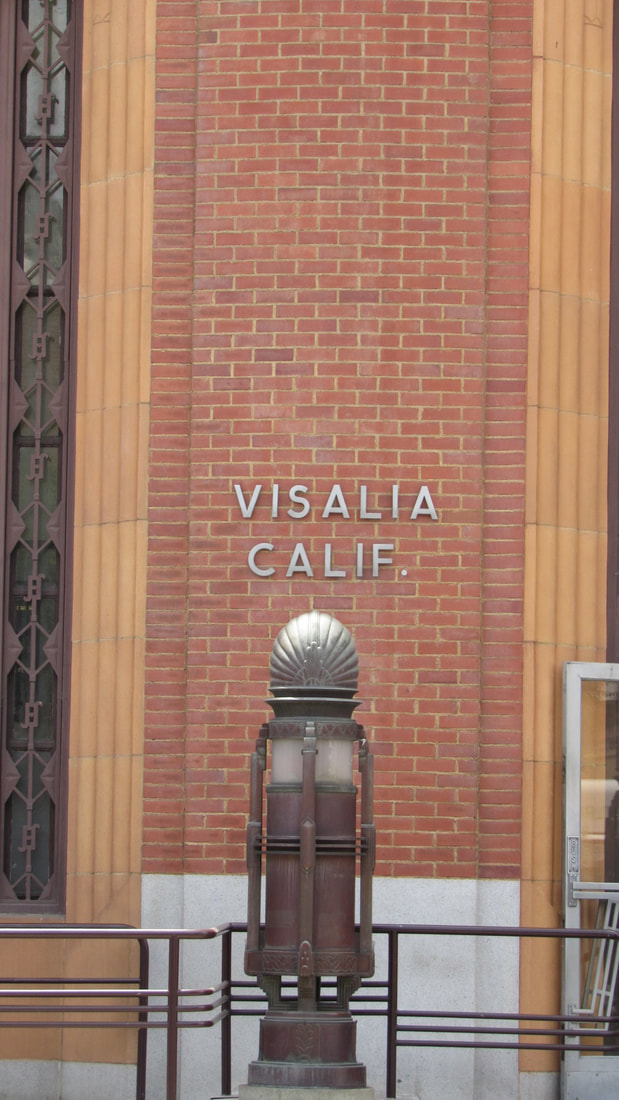
Like Porterville’s, its basic symmetrical exterior form is enlivened with Art Deco stylized plants, regal eagles, and many flower or sunburst motifs. They appear in the plaques and friezes above the tall north-facing windows, which feature elegant bronze-colored aluminum dividers. Cast aluminum panels below form ferny, feathery shapes along with zig-zags and chevrons.


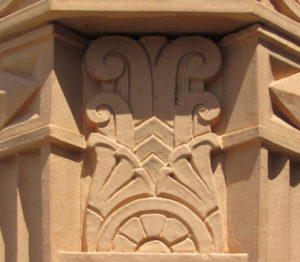
The raised brick panels on the russet-colored brick walls suggest simplified classical columns, topped with abstract designs in honey-colored terra cotta. Darker brick outlines a simple diamond pattern above the windows. The windows and doors are framed in the same terra cotta, grooved vertically to suggest columns again, and also grooved horizontally. The terra cotta panel running the length of the building at the top of the wall repeats the harmonious framing effect.


As at Porterville, light fixtures flank the entry stairs. These are bronze scallop shells, supported by decorated columns that continue the building’s mixture of organic designs with abstract geometric patterns. Inside, geometric forms in red, yellow, gray, and green enliven the lobby’s terrazzo floor, while marble paneling and door frames enrich the walls.


In the early 1980s, detailed restoration work was done at the Visalia post office, carefully following the specifications in Coates’s original drawings. The original service windows, bronze light fixtures, lobby desks (custom designed for the building), bronze post office boxes, and cast aluminum radiator grilles are all still in use 85 years after their installation. (Unfortunately, when the Porterville post office was remodeled in 1965, some of its original interior features and fixtures were lost.)


These two iconic buildings connect us still, physically and aesthetically, to key events in the history of our nation and our communities. They embody a significant period in architecture and decoration, and reflect the enormous changes that were occurring culturally, economically, and technologically when they were created. Innovative when they were built, enduringly attractive, they continue to delight us and serve us well into the twenty-first century. They are true treasures of Tulare County.
May, 2018



“The agencies of the Franklin D. Roosevelt administration had an enormous and largely unrecognized role in defining the public space we now use. In a short period of ten years, the Public Works Administration, the Works Progress Administration, and the Civilian Conservation Corps built facilities in practically every community in the country. Most are still providing service …. ” –Robert D. Leighninger
“[T]he second phase of Art Deco [was] known as Streamline Moderne, which began with the stock market crash and ended in most cases with the outbreak of World War II. It was less decorative — a more sober reflection of the Great Depression. It relied more on machine-inspired forms, and American ideas in industrial design. It was buttressed by the belief that times would get better and was infused with the optimistic futurism extolled at America’s Worlds Fairs of the 1930s.” — Miami Design Preservation League

“The stated goal of public building programs was to end the depression or, at least, alleviate its worst effects, Millions of people needed subsistence incomes. Work relief was preferred over public assistance (the dole) because it maintained self-respect, reinforced the work ethic, and kept skills sharp.” — Robert D. Leighninger

“The expanded federal construction program continued to maintain high standards for public building construction. Architects began introducing the new esthetic of industrial design, combining classical proportions with streamlined, Art Deco detailing. . . . It is a testimony to the durability of these buildings that many of them … continue to serve the functions for which they were built.” — General Services Administration/gsa.gov

“The ornamental terracotta and cast aluminum have no counterparts in the Porterville area, and are, in fact, typical of more urbanized areas such as San Francisco or Los Angeles. The terracotta roof is unusual for buildings in this style, though it is consistent with the local vernacular version of the Mission Revival style.” — NRHP Nomination Form
Even one or two striking historic buildings can help to define a community and hint at its past. The sense of history can contribute to community pride, and to a better understanding of the community’s present. — Community Tool Box

“Architecture is a direct and substantial representation of history and place. By preserving historic structures, we are able to share the very spaces and environments in which the generations before us lived. Historic preservation is the visual and tangible conservation of cultural identity.” — Washington Trust for Historic Preservation

W. D. Coates was raised in Fresno. From 1909 to 1911 he served as State Architect. In 1914, Coates moved back to Fresno. He designed the Liberty Theatre there, and also Fresno High School, Hanford High School, Exeter Grammar School, and Porterville High School. — mostly from Historic Fresno

“The country’s depressed economy forced modifications and cutbacks resulting in construction delays. For example, the use of aluminum for interior trim and grille work was in some places replaced with wrought iron painted to look like aluminum.” — Terry L. Ommen
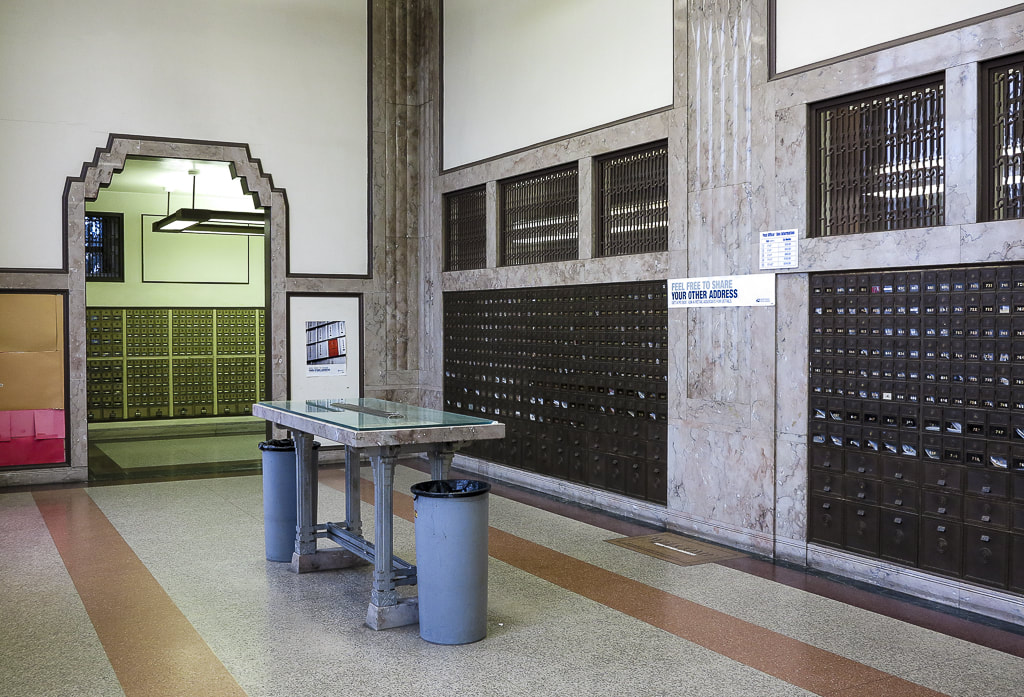
“The ornate cast aluminum grates and trim, bronze post office boxes, marble furnishings, and the multi-colored terrazzo lobby floor, make this interesting building a magnet for the curious, especially those with a fascination for architectural history.” — Terry L. Ommen
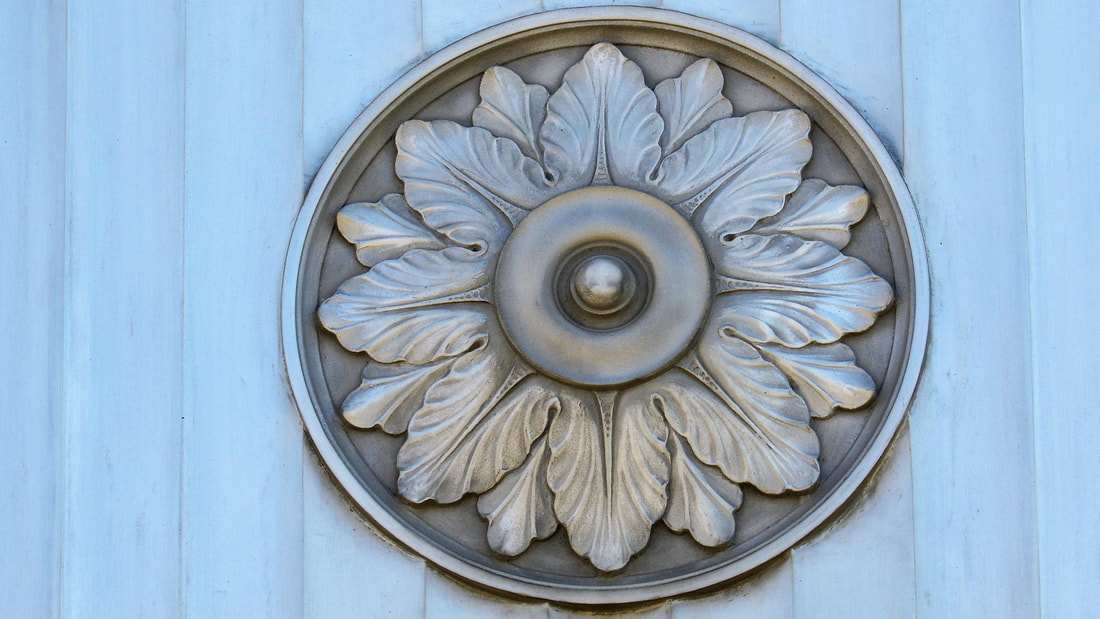
“More than any other man-made element, historic buildings differentiate one community from all others. The quality of historic buildings and the quality of their preservation says much about a community’s self image. A community’s commitment to itself is a prerequisite for nearly all quality of life elements. ” — preservation.lacity.org
Directions:
Address: 65 W. Mill Ave., Porterville, CA 93257
From Visalia, take Hwy 198 east to Spruce Ave. and go south on Spruce Ave. to the junction with Hwy 65.
Turn left onto Hwy 65 and follow it south to Porterville.
Exit east onto Olive Avenue, and then turn left (north) onto North Main Street. Turn left (west) onto West Mill Avenue. The Post Office is 2.5 blocks ahead on the left.
Directions:
Address: 111 West Acequia Ave., Visalia, CA 93291
From Hwy 198 West in Visalia, exit north onto Court Street.
Go two blocks north to Acequia Ave., and turn left (west). The post office is on the left.
There is parking on both sides of Acequia Ave.